By Marcus Reid · Updated June 18, 2026 · Research-based, safety-first guide · Price tiers, not fixed dollars.
Graco Simple Sway Baby Swing
Can a baby sleep in a swing? It is one of the most common questions new parents ask, often at 2 a.m. with a fussy newborn finally calm. Here is the short, honest answer: a baby swing…
🛡️ Why you can trust Baby Swing Club
- A swing is great for soothing a fussy baby while you watch, but it is never a safe place for your baby to sleep.
- Once your baby falls asleep in the swing, move them to a firm, flat crib or bassinet on their back, with no extra padding.
- Never add pillows or head supports that did not come with the swing, always buckle the harness, and respect the weight and age limits.
✓ Pros
- Power — AC adapter or batteries
- Motion — Side-to-side sway, 6 speeds
- Sound — 15 songs/sounds + vibration
- Footprint — Slim full-size frame
Can a baby sleep in a swing? It is one of the most common questions new parents ask, often at 2 a.m. with a fussy newborn finally calm. Here is the short, honest answer: a baby swing is a wonderful soothing tool, but it is not a safe place for your baby to sleep. The American Academy of Pediatrics (AAP) is clear that swings, bouncers, and other inclined seats are not safe-sleep surfaces. The safest spot for sleep is always a firm, flat surface, on the back, with nothing else in the bed.
I get why this feels confusing. The swing rocks. It hums. It often does the one thing you have been begging for all day, which is to make the crying stop. So when your little one drifts off in the seat, the last thing you want to do is move them. But the gentle slope and soft padding that make a swing so soothing are exactly what make it risky for sleep. A baby who slumps forward can struggle to breathe, and that risk is highest in the first few months.
This guide walks you through what the research actually says, why the rules exist, and what to do instead when your baby keeps nodding off mid-rock. We will cover the real difference between supervised soothing and true sleep, the age and weight rules that matter most, the mistakes parents make without realizing it, and gentle ways to move a sleeping baby to a safe spot. You will also find a quick do-and-don’t table, expert tips, real-life scenarios, and answers to the questions parents search for most. My goal is simple: help you keep using your swing the smart way, soothe with confidence, and protect your baby’s sleep at the same time. Let us get into it.
- The short answer: can a baby sleep in a swing?
- Why parents ask this in 2026
- Soothing vs. sleeping: the key difference
- Why sleeping in a swing is risky
- How to use a swing safely (step by step)
- What to do when your baby falls asleep
- Age, weight, and when to stop
- Common mistakes (and easy fixes)
- Expert and pro tips
- Real-life scenarios
- FAQs
- Key takeaways and safety checklist
The short answer: can a baby sleep in a swing?
No. A baby should not sleep in a swing. A swing is great for soothing a baby who is awake and watched, but it is not a safe place for sleep. The AAP recommends that babies sleep on a firm, flat surface like a crib, bassinet, or play yard, always on their back, with no pillows, blankets, or padding. A swing seat sits at an angle, and that angle is the problem.
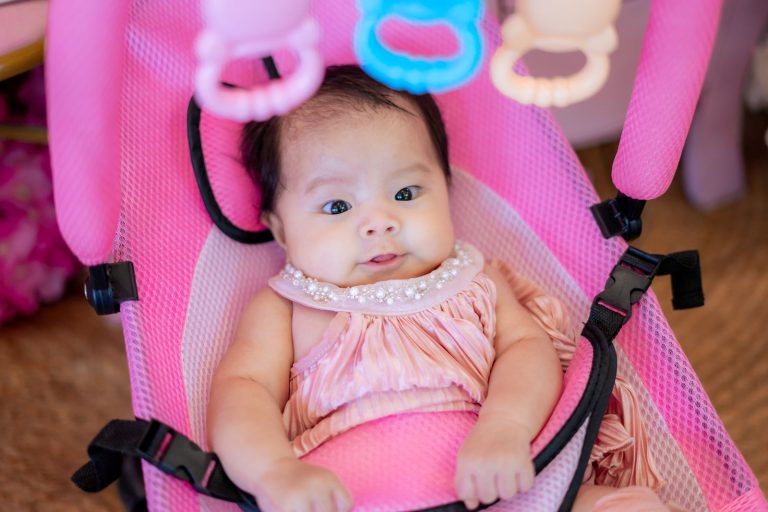
Here is why the angle matters. Newborns have heavy heads and weak neck muscles. When a young baby sleeps in a reclined seat, the head can fall forward and press the chin to the chest. That position can narrow the airway and make breathing harder. The baby may not be able to lift or turn the head to fix it. This is the main reason safe-sleep experts draw such a hard line on inclined seats and sleep.
That does not mean the swing is bad. It means the swing has a job, and sleep is not part of that job. Use it to calm a crying baby during the day while you stay close. The moment real sleep begins, the plan changes: move your baby to a flat, safe spot. Think of the swing as a soothing station, not a bed.
A quick real-life example. You are making dinner one-handed while your newborn fusses in the swing. The motion calms her and her eyes get heavy. That is fine while you are right there watching. But if she truly falls asleep, the safe move is to pause, scoop her up, and lay her down flat in the bassinet. Want a deeper dive into the safety rules? Our are baby swings safe explainer breaks it all down.
Why parents ask this in 2026
Parents ask this question more than ever, and for good reason. Swings are everywhere now. They rock, play white noise, connect to apps, and run for hours. They are so good at soothing that babies often fall asleep in them, which leads straight to the big question: is that okay?
It matters because the stakes are high. Safe sleep is one of the few areas where small choices have a big impact. The federal Safe Sleep for Babies Act, which took effect in 2022, banned the sale of inclined sleep products designed for infant sleep. That law exists because inclined seats were linked to infant deaths. Swings are not sold as sleepers, but the same physics apply when a baby sleeps in one.
It also matters because the advice can feel like a moving target. You may have heard one thing from a friend, another from a relative, and a third from a product label. The rules have tightened over the years as more data came in. In 2026, the guidance is steady and clear: swings for soothing, flat surfaces for sleep. Knowing the why helps you hold the line, even when you are exhausted.
A real-life example: a weekend at grandma’s house. Grandma raised three kids who napped in swings and turned out fine, so she does not see the harm. You are not trying to start a fight, but you do want to keep your baby safe. Understanding the current research gives you a calm, confident way to explain it. If you are weighing a swing nap against other options, our guide on baby swing vs. car seat for naps is a helpful read too.
Soothing vs. sleeping: the key difference
The single most useful idea in this whole topic is the line between soothing and sleeping. They look similar, but they are not the same thing, and the safety rules are different for each.
Soothing is calming a baby who is awake or drifting. The baby may have heavy eyes, slow blinks, and a relaxed body. This is the swing’s sweet spot. As long as you are nearby, watching, and the harness is buckled, supervised soothing in a swing is fine. Sleeping is when the baby is truly out, with steady breathing and full rest. That is when the swing stops being safe and a flat surface becomes the only good choice.
Why does this line matter so much? Because risk goes up the moment supervision drops or the nap gets long. A baby who is watched can be helped if the head slumps. A baby left to sleep alone in a swing cannot. The angle, the soft sides, and the harness that holds the body in place all become hazards during unsupervised sleep.
How to use this in real life: treat drowsiness as a signal, not a finish line. When your baby gets sleepy in the swing, that is your cue to get ready to move, not your cue to walk away. Keep your eyes on the chest and chin. If the head starts to drop forward, adjust the recline or pick the baby up.
A swing can rock your baby to the edge of sleep. Your job is to catch them before they fall all the way in, and carry them to a flat, safe bed.
Why sleeping in a swing is risky
It helps to understand the actual risks, not just the rule. When you know the why, the rule sticks. There are three main dangers when a baby sleeps in a swing.
1. Positional asphyxia. This is the big one. In a reclined seat, a young baby’s head can tip forward so the chin rests on the chest. That can fold the airway and cut off airflow. Babies under four months are most at risk because they cannot reliably lift or reposition their heads. This is the core reason the AAP warns against sleep in any inclined seat.
2. Rolling and slumping to the side. Even with a harness, a baby can slump sideways against the soft fabric of the seat. Soft, curved surfaces near a sleeping baby’s face raise the risk of rebreathing and suffocation. A flat crib mattress does not have those soft pockets.
3. Falls and unbuckled escapes. Older babies who can wiggle, push up, or lean may shift their weight and tip the seat or climb partway out, especially if the harness is loose or unbuckled. A sleeping baby cannot brace for a fall.
A real-life example shows how fast this happens. A light-sleeping baby finally konks out in the swing after a rough afternoon. You step into the next room to fold laundry, sure you will hear any fuss. But a slumped head makes no noise. That silent risk is exactly why supervision and a flat sleep surface are non-negotiable. For more on body shape and positioning, see our piece on do baby swings cause flat head, and read about real-world hazards in our baby swing recalls tracker.
How to use a swing safely (step by step)
Used the right way, a swing is one of the most helpful tools in your house. The key is supervised soothing, never sleep. Follow these steps every time and you will get the calming benefit without the risk.
- Read the manual first. Check the weight range, the age range, and the recline settings. Every swing is a little different, and the maker’s limits matter.
- Set the most reclined position for newborns. Young babies without strong head control need the flattest setting the swing allows. This keeps the chin off the chest.
- Buckle the harness fully. Use both the waist and crotch straps. A snug harness keeps your baby from slumping or sliding, even during soothing.
- Place the swing on a flat, clear floor. Keep it away from cords, curtains, stairs, and direct sun. Never put a swing on a table, bed, or raised surface.
- Stay within arm’s reach. Soothing means you are watching. Keep your eyes on the chest and chin the whole time.
- Limit each session. Many experts suggest keeping swing time short, often under 30 minutes at a stretch and not too many sessions a day. See our notes on how long a baby can be in a swing.
- Move at the first sign of real sleep. When the soothing turns into sleeping, gently lift your baby out and lay them flat on their back in a crib or bassinet.
A real-life example: it is the middle of the afternoon in a small apartment, and your baby is overtired and cranky. You set the swing to its flattest recline, buckle her in snug, and sit on the couch right beside her with a coffee. She calms within minutes. You watch her chest rise and fall. When her blinks turn to real sleep, you scoop her up and lay her in the bassinet two feet away. That is the model: soothe close, sleep flat.
- Never for sleep. Per AAP guidance, swings and inclined seats are not safe-sleep surfaces. If your baby dozes off, move them to a firm, flat crib or bassinet on their back.
- Always buckle the harness and never leave a baby unattended.
- Recline newborns in the most-reclined position until they have solid head control.
- Respect the weight limit and stop use once your baby can sit up unassisted. Buy only gear that meets ASTM/CPSC standards — see our safety standards guide.
What to do when your baby falls asleep
So your baby drifted off in the swing. It happens to every parent. The good news is that moving a sleeping baby is a skill you can learn, and it gets easier with practice. Here is how to do it without waking them, and why it is worth the effort.
Why bother moving them at all? Because the flat crib or bassinet removes the angle, the soft sides, and the harness pressure that make swing sleep risky. Even a perfect-looking nap in a swing carries the breathing risk we covered earlier. A quick transfer trades a small chance of a fuss for a much safer sleep.
How to move a sleeping baby smoothly:
- Pause the motion first. Turn off the swing and let your baby settle into stillness for a moment before you lift.
- Unbuckle quietly. Release the harness slowly to avoid sudden movement.
- Support the head and bottom. Slide one hand under the head and neck, the other under the bottom, and lift as one steady unit.
- Hold close, then lower slow. Keep your baby snug against your chest for a few seconds, then lower them onto the flat mattress bottom-first, head last.
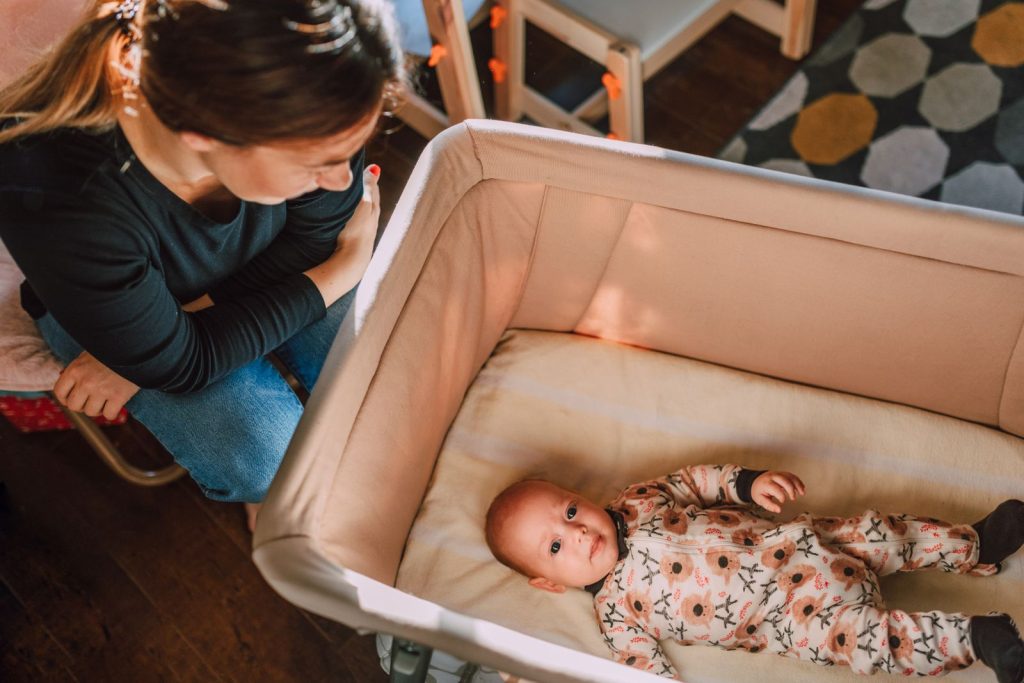
- Lay on the back, keep it bare. No blankets, pillows, or toys. A firm flat surface and a fitted sheet only.
- Rest a hand on the chest. A gentle hand for a moment can ease the transition before you slip away.
A real-life example: it is the dreaded 2 a.m. stretch. Your baby finally sleeps in the swing and you are tempted to leave well enough alone. Instead, you pause the swing, count to ten, unbuckle, and do the slow transfer to the bassinet by your bed. Yes, sometimes they stir. But a five-minute resettle is a fair trade for safe sleep. If swing dependence is becoming a pattern, our guide to get your baby to sleep without the swing has gentle weaning steps.
Age, weight, and when to stop
The swing rules change as your baby grows. What is safe for a sleepy newborn during supervised soothing is different from what works for a strong, rolling six-month-old. Two limits matter most: weight and milestones.
Weight limit. Every swing has a maximum weight set by the maker, and you should never go over it. The exact number varies by model, so check your manual. Going past the limit can stress the frame and motor and make the seat tip more easily.
The big milestone: sitting up and rolling. Once your baby can push up on hands and knees, roll over, or sit unassisted, swing time should stop. A baby with that much strength can shift weight, lean, or try to climb out, which can tip the swing. This usually lines up with the maker’s age guidance, but watch your baby, not just the calendar.
Here is a simple way to think about safe soothing versus unsafe sleep across the stages:
A real-life example: your five-month-old just figured out how to roll both ways. He still loves the swing’s motion, but now he arches and twists in the seat. That is the signal. It is time to retire the swing and switch to floor play or a stationary seat. For the full breakdown, see our guides on weight and age limits and when to stop using a baby swing.
Common mistakes (and easy fixes)
Most swing mishaps come from small, well-meaning habits. Here are the ones I see most, and the simple fix for each.
Mistake 1: Leaving a sleeping baby in the swing
This is the most common and the most serious. A baby falls asleep, the house is finally quiet, and the swing keeps running for an hour. Fix: treat sleep as your cue to move. Pause, unbuckle, and transfer to a flat surface every single time.
Mistake 2: Skipping the harness
It feels harmless for a quick soothe, but an unbuckled baby can slump, slide, or wiggle into a bad position fast. Fix: buckle every time, even for two minutes.
Mistake 3: Using too steep a recline for a newborn
A more upright seat looks cozy, but a newborn’s head can drop forward. Fix: use the flattest recline until your baby has solid head control.
Mistake 4: Going over the weight or age limit
Squeezing a few extra weeks out of a beloved swing is tempting. Fix: respect the maker’s limits and stop once your baby can sit up. See baby swing mistakes to avoid for the full list.
Mistake 5: Placing the swing in an unsafe spot
Near cords, on a raised surface, or in a busy walkway invites trouble. Fix: a flat, clear floor away from hazards, every time.
A real-life example ties these together: a parent props the newborn slightly upright so she can see the room, skips the crotch strap for a quick soothe, and steps away when she dozes. Three small mistakes stacked into one risky nap. Fixing any one of them breaks the chain.
Expert and pro tips
Drawing on the safety research, here are the habits that separate confident parents from stressed ones.
- Build a transfer routine. The same pause-unbuckle-lift-lower steps every time train both you and your baby for smoother moves.
- Use the swing earlier, not later. Soothe before your baby is fully overtired. Calmer babies transfer to the crib more easily.
- Pair the swing with white noise that travels. If the same sound plays in the crib, the change of place feels smaller. See white noise and music tips.
- Keep the crib ready. A made-up, bare bassinet within reach means you never hesitate at transfer time.
- Watch the chin, not the clock. Head position is the real safety signal, not just minutes elapsed.
- Know your model. Re-check the recline and harness each time, since settings can shift.
Real-life scenarios
Rules are easier to follow when you can see them in action. Here are common situations parents face, and the safe move for each.
The small apartment with no nursery
Your living room is the swing room, the play room, and the nap room. That is fine. Keep a bassinet on wheels nearby so the safe-sleep spot is always within steps. Soothe in the swing, then roll the bassinet over and transfer.
Making dinner one-handed
You need both hands for ten minutes. The swing buys you that time safely, as long as you can see your baby from the stove and the harness is buckled. If your baby falls asleep before dinner is done, turn off the burner for a moment and move them first.
A weekend at grandma’s house
Different house, same rules. Bring or borrow a travel bassinet or play yard so there is a flat, safe sleep surface wherever you go. A swing at grandma’s is for supervised soothing only. For tips on gear away from home, see traveling with a baby swing.
The 2 a.m. battery swap
The swing dies mid-soothe and your baby stirs. This is a sign to switch plans, not to scramble for batteries. If your baby is calm, move to the crib. If wide awake, soothe with your arms or a quick rock, then lay flat. Motion should never be the thing that keeps a baby asleep all night.
The light-sleeping baby who wakes on transfer
Some babies stir the second you lift them. Slow everything down: pause the swing longer, lift in one smooth motion, and lower bottom-first. A warm (not hot) crib sheet and steady white noise can soften the change. A few stirs are worth a safe sleep.
FAQs
Can a baby sleep in a swing for just a short nap?
No, not for any sleep, short or long. The breathing risk from the reclined angle is present even in a brief nap, especially for babies under four months. Use the swing to soothe, then move your baby to a flat surface for sleep.
Can a baby sleep in a swing if I am watching the whole time?
Supervised soothing is fine, but true sleep should still happen on a flat surface. Watching reduces some risk, but the head can still drop forward into a dangerous position. The safest plan is to move your baby once they are truly asleep.
What does the AAP say about swings and sleep?
The AAP says babies should sleep on a firm, flat, separate surface on their backs, and that swings, bouncers, and inclined seats are not safe for sleep. If your baby falls asleep in a swing, the AAP advises moving them to a safe sleep surface as soon as you can.
Why is a slightly inclined swing dangerous for sleep?
The angle lets a young baby’s heavy head fall forward, which can press the chin to the chest and narrow the airway. Babies under four months often cannot lift or turn their heads to fix it. A flat surface removes that risk.
How long can my baby stay in a swing while awake?
Many experts suggest keeping each swing session short, often under 30 minutes, and limiting total daily time. Too much time in any one position is not ideal for development. Our how long a baby can be in a swing guide covers this in detail.
My baby only sleeps in the swing. What do I do?
This is common and fixable. Slowly shift sleep to a flat surface by soothing in the swing, then transferring before deep sleep, and gradually shortening the swing step. Our walkthrough on get your baby to sleep without the swing lays out gentle steps.
Are newborns at higher risk than older babies?
Yes. Newborns have the weakest head and neck control, so they are most likely to slump into an unsafe position. Risk is highest in the first few months. Read more in are baby swings safe for newborns.
Is a swing better or worse than a car seat for naps?
Both are inclined seats and neither is safe for routine sleep at home. A car seat is necessary in the car, but once you are home, move your baby to a flat surface. See baby swing vs. car seat for naps for the full comparison.
Key takeaways and safety checklist
Here is everything in one place. Use this as your quick reference before every swing session.
- Swings soothe; flat surfaces are for sleep. Never let your baby sleep in a swing.
- If your baby dozes off, move them. Pause, unbuckle, and transfer to a firm, flat crib or bassinet on the back.
- Buckle the harness every time and stay within arm’s reach.
- Recline newborns fully until they have strong head control.
- Respect the weight limit and stop using the swing once your baby can sit up unassisted.
- No extra padding or aftermarket inserts in the seat.
- Place the swing on a flat, clear floor, away from cords and raised surfaces.
- Buy gear that meets ASTM/CPSC standards and check for baby swing recalls.
Bottom line: a swing is a fantastic helper when you use it for what it does best, which is calming a baby who is awake and watched. Keep sleep flat, keep soothing supervised, and you get the best of both. Ready to find a model that fits your home? Start with our best baby swings roundup, and lean on our are baby swings safe and safety standards guide guides whenever you need a refresher.
The bottom line
After weighing its specifications, safety guidance and owner feedback, the Graco Simple Sway Baby Swing earns its spot among our top recommendations. Check the latest price and availability below.